Product Description
Double Pipe Heat Exchanger
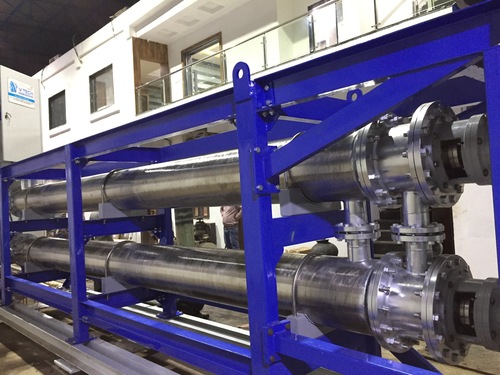
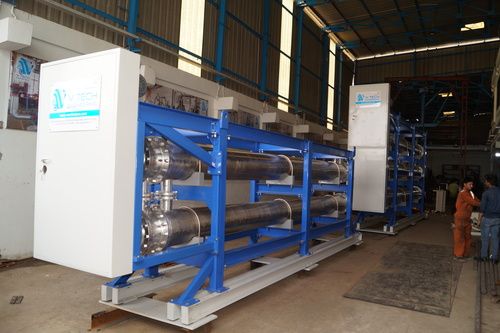
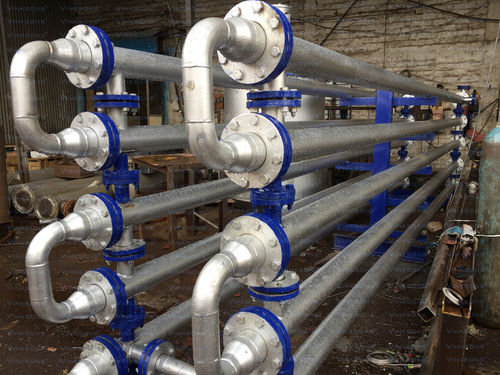
A Double Pipe Heat Exchanger is, in its simplest form, one pipe held concentrically inside of a larger pipe (thus the name double pipe). The inner pipe acts as the conductive barrier, where one fluid flows through this inner pipe and another flow around it through the outer pipe, forming an annulus shape. Heat exchangers are devices that transfer or exchange heat between two fluids without mixing and include various types depending on the design, application, required space, and the fluid flows in the system. The offered Double Pipe Heat Exchanger is made for use in various commercial applications.
Robust and Versatile ConstructionBuilt from Stainless Steel 304/316 or Carbon Steel, the double pipe heat exchanger offers adaptability for different process conditions and fluid types. The high corrosion resistance and customizable thicknesses ranging from 3 mm to 8 mm ensure durability. With options for flanged, threaded, or specialized connections, each unit is fabricated to client specifications, making it suitable for diverse industrial needs.
Efficient Heat Transfer for Industrial ApplicationsEngineered to provide effective heat exchange between liquids and gases, the double pipe design ensures optimal flow and maximum surface contact. With a heat transfer area up to 12 m2 per unit and a capacity of up to 200,000 kcal/hr, it maintains temperatures from -10C to 180C. Its horizontal orientation and modular skid or floor mounting simplify integration into existing setups.
User-Friendly Maintenance and InstallationMaintenance is straightforward, thanks to the simple design and easy accessibility for cleaning. The system is non-electrically powered, relying solely on fluid flow, which reduces operational costs. Installations can be rendered on the floor or as skid-mounted modules, tailored according to your plant's requirements, ensuring minimal downtime and consistent performance.
FAQ's of Double Pipe Heat Exchanger:
Q: How does a double pipe heat exchanger facilitate efficient heating or cooling of process fluids?
A: A double pipe heat exchanger utilizes a concentric pipe arrangement, where one fluid flows through the inner pipe and the other through the annular space between pipes. This counterflow setup maximizes temperature gradients, ensuring high thermal efficiency for heating or cooling liquids and gases.
Q: What materials are available for construction, and how do they influence corrosion resistance?
A: These exchangers are constructed from Stainless Steel 304/316 or Carbon Steel, selected based on chemical compatibility and corrosion resistance needs. Stainless steel grades offer excellent resistance in corrosive environments, making them ideal for aggressive process fluids.
Q: When should I opt for flanged, threaded, or customized connection types?
A: The choice of connection depends on system requirements and maintenance preferences. Flanged connections are preferred for easy assembly and disassembly in large systems, while threaded options suit smaller, low-pressure applications. Customized connections can address unique integration challenges.
Q: Where can a double pipe heat exchanger be installed within my facility?
A: Installation is flexible; units can be floor-mounted or skid-mounted, fitting seamlessly into various industrial layouts. Their horizontal orientation and customizable dimensions make them suitable for compact or expansive process areas alike.
Q: What is the maintenance process for these heat exchangers, and why is it considered easy?
A: Maintenance involves routine inspection and cleaning, facilitated by the straightforward double pipe design. End covers can be removed to access inner surfaces, reducing downtime and ensuring prolonged, efficient operation.
Q: How is the heat transfer area determined, and what advantage does customizable sizing offer?
A: Heat transfer area, up to 12 m2 per unit, is engineered based on required capacity and process parameters. Custom dimensions ensure each unit meets specific thermal duty demands, providing scalability and operational efficiency for varying industrial processes.
Q: What are the key benefits of using a double pipe heat exchanger in process industries?
A: These units deliver high thermal efficiency, robust construction, adaptability to challenging environments, simple maintenance, and easy integration. They support a wide range of temperature and flow conditions, offering reliability across diverse applications.

 English
 Spanish
 French
 German
 Italian
 Chinese (Simplified)
 Japanese
 Korean
 Arabic
 Portuguese




 Send Inquiry


